
Humanoid Robot ‘Surgie’ Makes History by Assisting in World’s First Live Animal Gallbladder Surgeries
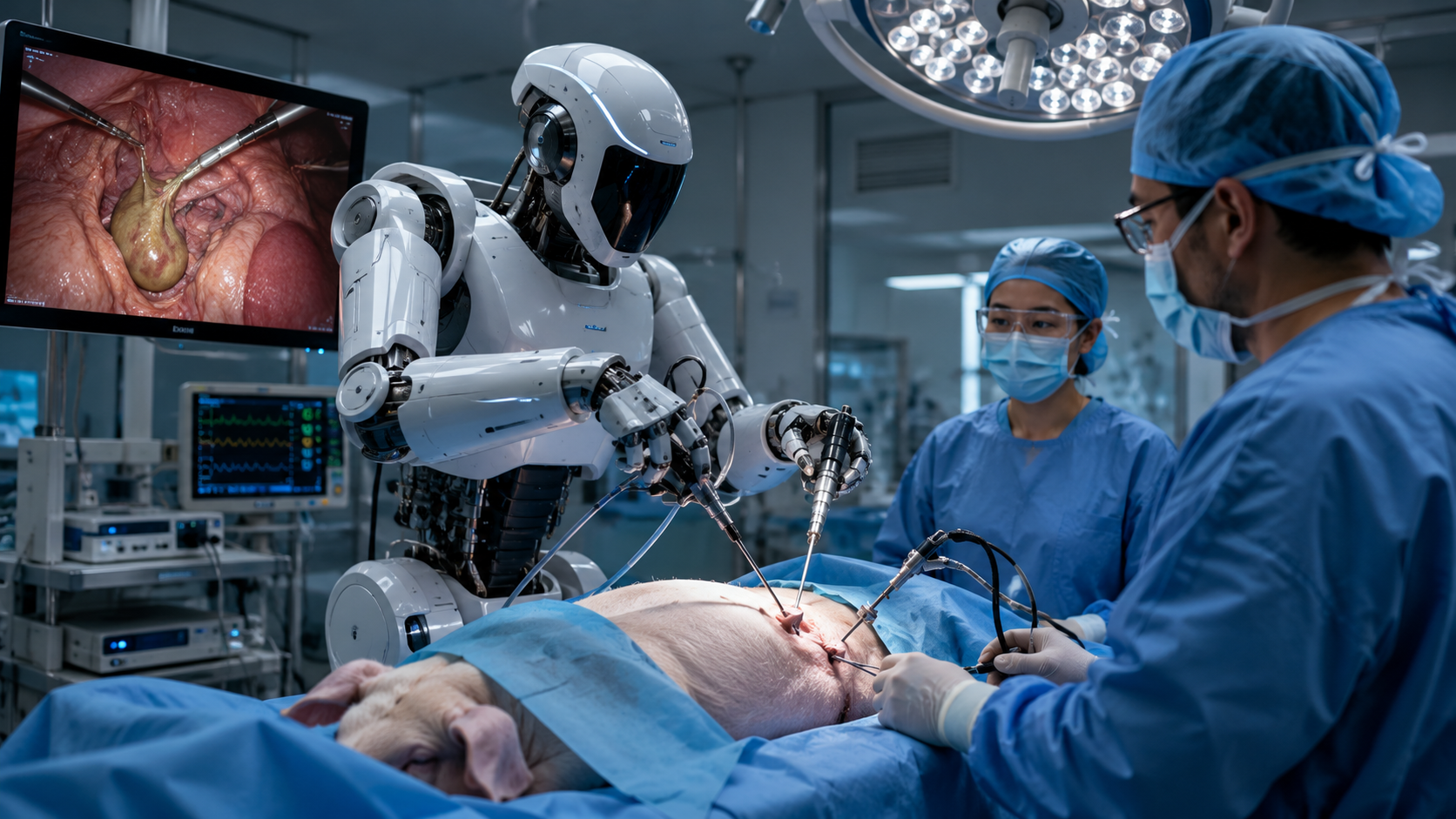
A team of researchers from the University of California San Diego has achieved a major milestone in medical robotics by successfully using a humanoid robot named Surgie to perform two minimally invasive gallbladder surgeries on live pigs. The proof-of-concept study marks the first time humanoid robots have participated in live surgical procedures on animals, highlighting the growing potential of robotic systems in healthcare.
During the trials, one operation was completed by a team consisting of a human surgeon and a teleoperated humanoid robot, while the second procedure saw two humanoid robots working together under remote human control. Both surgeries involved laparoscopic gallbladder removal and were successfully completed on large non-primate mammals. Researchers emphasized that the robots were not operating autonomously but were guided by experienced surgeons throughout the procedures.
Unlike conventional surgical robots that are large, expensive, and require dedicated operating rooms, Surgie is a compact humanoid robot designed to use standard surgical instruments. Researchers believe its smaller size, lower cost, and portability could make advanced robotic surgery more accessible in rural hospitals, emergency situations, military environments, and even future space missions.
Although the surgeries took longer than standard robotic procedures because the robots required periodic recalibration, the research team considers the results a significant step toward expanding robotic-assisted healthcare. Future improvements are expected to enhance precision, reduce setup time, and eventually enable broader clinical applications.
The researchers also see teleoperated humanoid robots as a possible solution to the growing shortage of surgeons worldwide. By allowing specialists to remotely perform procedures in underserved regions, the technology could improve access to advanced surgical care while supporting healthcare systems facing workforce challenges. Human oversight, however, will remain a critical part of the process as the technology continues to evolve.