COBALT App Lets Anyone Control Robots From a Smartphone Without Coding
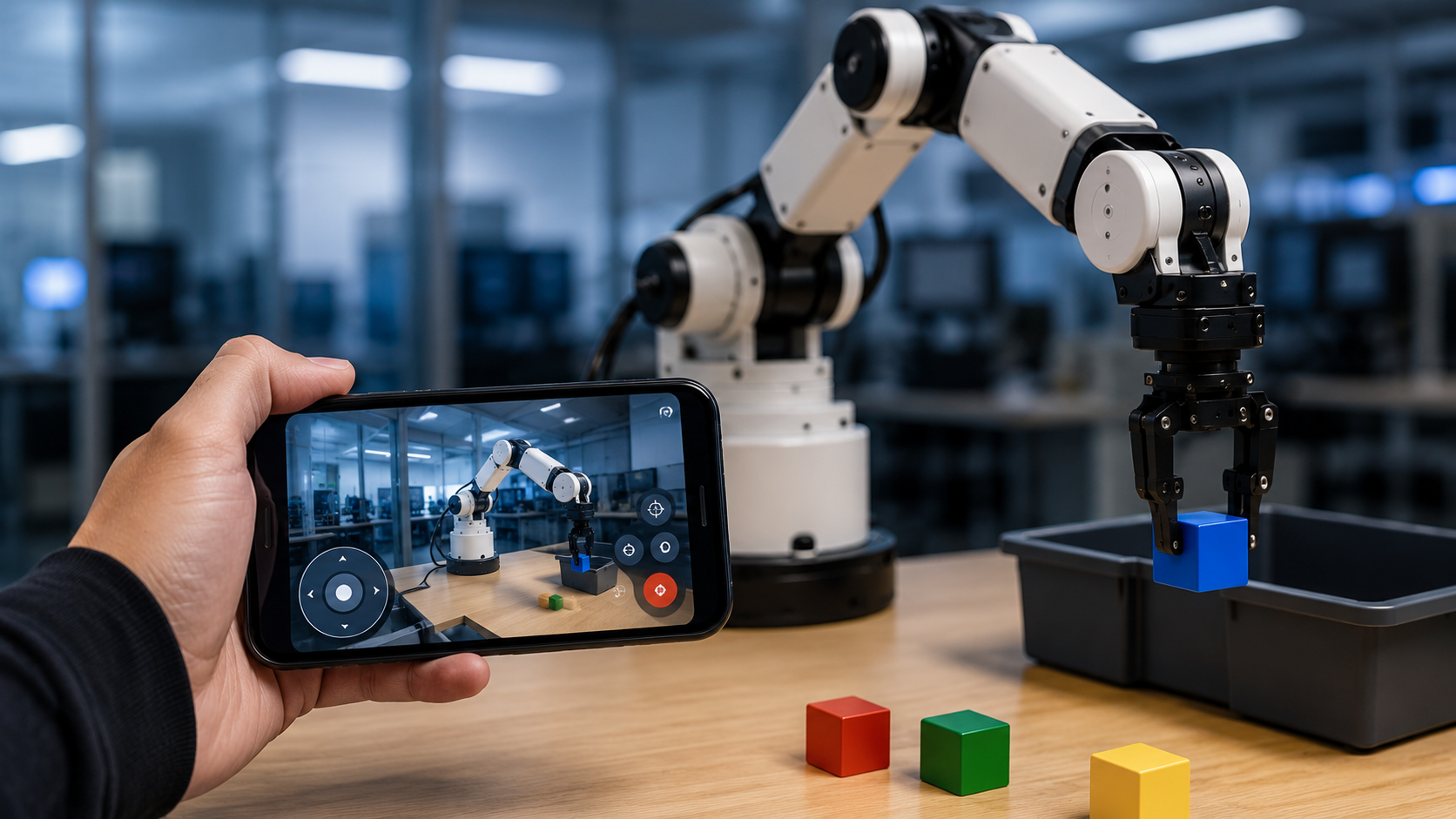
Researchers from Georgia Tech and several partner institutions have developed a new smartphone-based platform that allows people to remotely control robots from anywhere in the world without requiring any technical expertise. Called COBALT, the system transforms an ordinary smartphone into a controller for robotic arms, potentially opening the door to large-scale robot training, remote work opportunities, and wider access to robotics education.
The platform enables users to operate a robot arm simply by moving their smartphone. Using a secure internet connection and real-time video feedback, the robot mirrors the phone's movements, allowing users to perform tasks such as picking up, moving, and releasing objects. The experience is designed to be intuitive, making robot operation feel more like using a mobile app or playing a smartphone game than controlling complex machinery.
The project was developed by researchers at Georgia Tech's People, AI & Robotics (PAIR) Lab in collaboration with experts from UC Berkeley, NYU Abu Dhabi, the University of Toronto, and Nvidia. The team recently presented its findings at the IEEE International Conference on Robotics and Automation in Vienna.
Beyond remote control, the researchers see COBALT as a solution to one of robotics' biggest challenges: collecting enough real-world data to train AI-powered robots. Modern robotic systems require vast amounts of operational data to learn tasks reliably, and simulations alone are often insufficient. By allowing millions of smartphone users to interact with robots, researchers hope to create a crowdsourced data collection network capable of accelerating robot learning on a global scale.
Testing involved participants from multiple countries, including users with no previous robotics experience. Researchers found that the data generated through smartphone control was comparable in quality to data collected using more specialized devices such as virtual reality headsets, controllers, keyboards, and computer mice.
The team believes the technology could also play a significant role in education by giving students access to robotics without expensive equipment. Schools could allow students to remotely operate real robots through their phones, helping make robotics and computer science learning more accessible.
Researchers also envision future commercial applications, including a robot-assisted gig economy. In such a system, people could remotely control robots in homes, factories, or warehouses whenever human intervention is needed. A largely autonomous robot could perform most tasks independently and request assistance from a remote operator when it encounters a situation it cannot handle.
COBALT relies on WebRTC technology, commonly used in video conferencing platforms such as Zoom and Google Meet, to maintain low-latency communication between users and robots. This ensures that robot movements and video feeds remain responsive even when operators are located thousands of miles away.
With billions of smartphone users worldwide, the researchers believe COBALT could significantly expand participation in robotics while helping accelerate the development of more capable autonomous systems through large-scale crowdsourced training data.