
Microsoft Unveils Majorana 2 Quantum Chip, Claims 1,000x Reliability Boost and Targets Scalable Quantum Computing by 2029
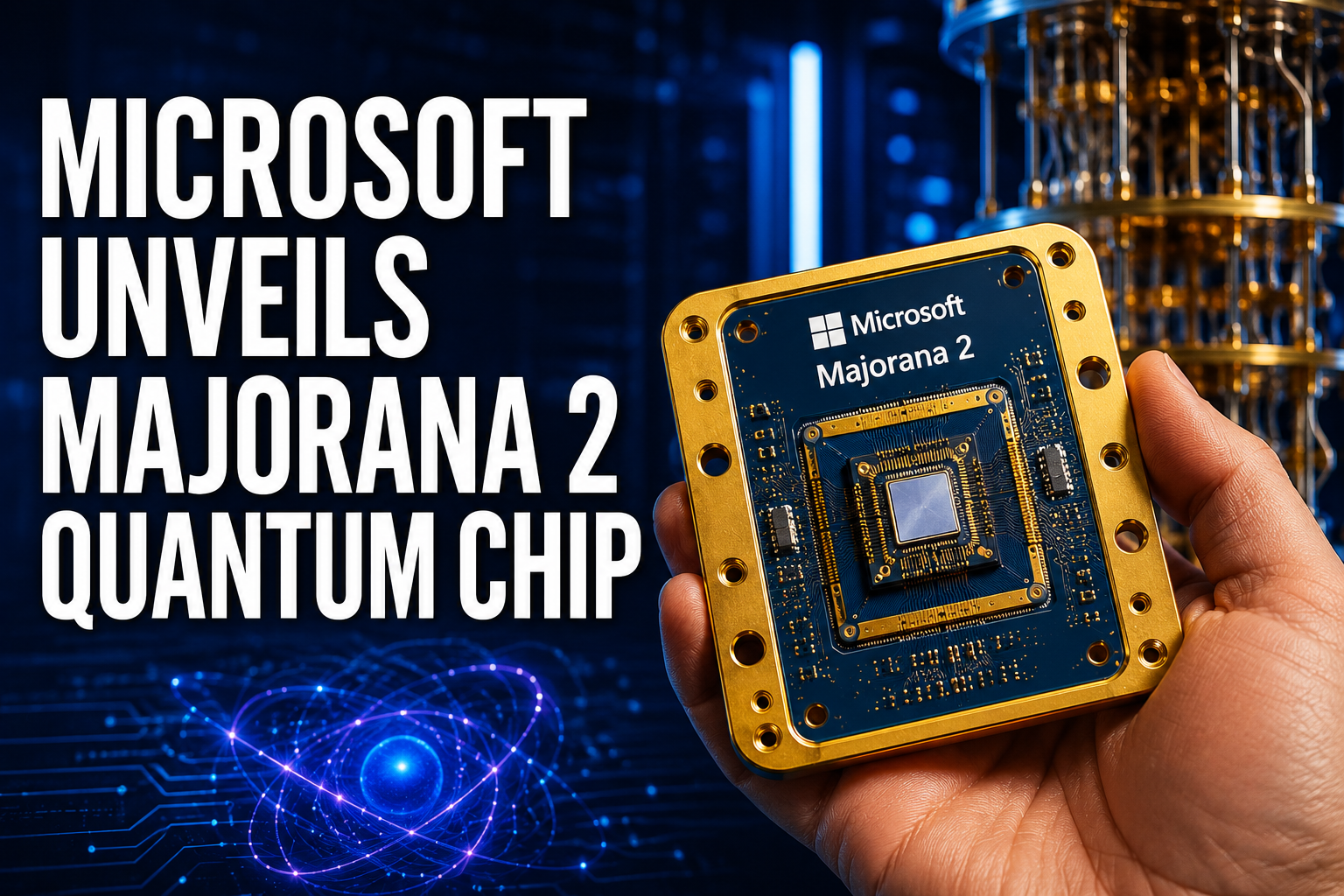
Microsoft has unveiled Majorana 2, its latest quantum computing chip, marking what the company describes as a major breakthrough in its quest to build a commercially useful quantum computer by 2029.
The new processor is based on Microsoft's topological quantum computing approach and delivers a significant leap in qubit reliability. According to the company, Majorana 2's qubits are 1,000 times more reliable than those used in the previous-generation Majorana 1 chip introduced in 2025.
One of the most notable improvements is qubit stability. While many quantum computing systems measure qubit lifetimes in microseconds, Microsoft says Majorana 2 achieves an average qubit lifetime of 20 seconds, with some qubits remaining stable for up to one minute. The company believes this advancement addresses one of the biggest challenges in quantum computing: keeping qubits stable long enough to perform meaningful calculations.
Majorana 2 currently contains 12 qubits and performs operations in approximately one microsecond. Microsoft says the qubits themselves are extremely compact, measuring just one-hundredth of a millimeter, which could help support future scaling efforts.
The announcement represents the latest milestone in Microsoft's two-decade pursuit of topological quantum computing. Unlike conventional quantum systems, Microsoft's approach relies on topological qubits built using exotic quantum states associated with Majorana particles, theoretical entities first proposed by Italian physicist Ettore Majorana in the 1930s.
A major change in the new chip is its materials design. While Majorana 1 used aluminum-based superconductors, Majorana 2 utilizes lead-based superconductors. Microsoft says lead offers improved protection against environmental disturbances and cosmic interference that can destabilize fragile qubits. The company credits this materials change as a key factor behind the dramatic increase in device reliability.
Microsoft's quantum team also highlighted the growing role of artificial intelligence in accelerating research and development. The company revealed that its Microsoft Discovery platform and agentic AI systems have become deeply integrated into the quantum program, assisting researchers with tasks such as materials optimization, experiment automation, data analysis, fabrication improvements, and anomaly detection.
According to Microsoft, AI agents can process vast amounts of scientific data, identify hidden patterns, generate research hypotheses, and automate complex measurement procedures that would otherwise take researchers weeks to complete manually. Company executives described AI-assisted measurement automation as a major breakthrough that significantly accelerated the development cycle of the Majorana 2 project.
Alongside the chip announcement, Microsoft confirmed the general availability of Microsoft Discovery, its AI-powered research platform designed to support scientific and engineering innovation. The company also introduced an early preview version of a Discovery application that individuals can run locally using a GitHub Copilot account.
Despite Microsoft's optimism, some experts remain cautious. Quantum computing has long been viewed as one of the most challenging fields in technology due to the extreme fragility of qubits. The company itself has faced skepticism in the past, including controversy surrounding a 2018 research paper that was later retracted.
Researchers outside Microsoft note that many technical details behind the latest claims have not yet been fully disclosed publicly. Although the company has published supporting research, some findings are still awaiting broader peer review.
Nevertheless, Microsoft remains confident that the progress demonstrated by Majorana 2 keeps it on track toward building a scalable quantum computer capable of solving commercially valuable problems by the end of the decade.
If successful, such systems could help tackle challenges that are currently beyond the reach of traditional computers, including advanced materials discovery, sustainable energy research, fertilizer development, drug discovery, climate modeling, and the elimination of harmful environmental pollutants such as microplastics and forever chemicals.
With technology giants, startups, and research institutions competing in the global quantum race, Microsoft's latest announcement positions the company as an increasingly serious contender in the effort to bring practical quantum computing into the real world.